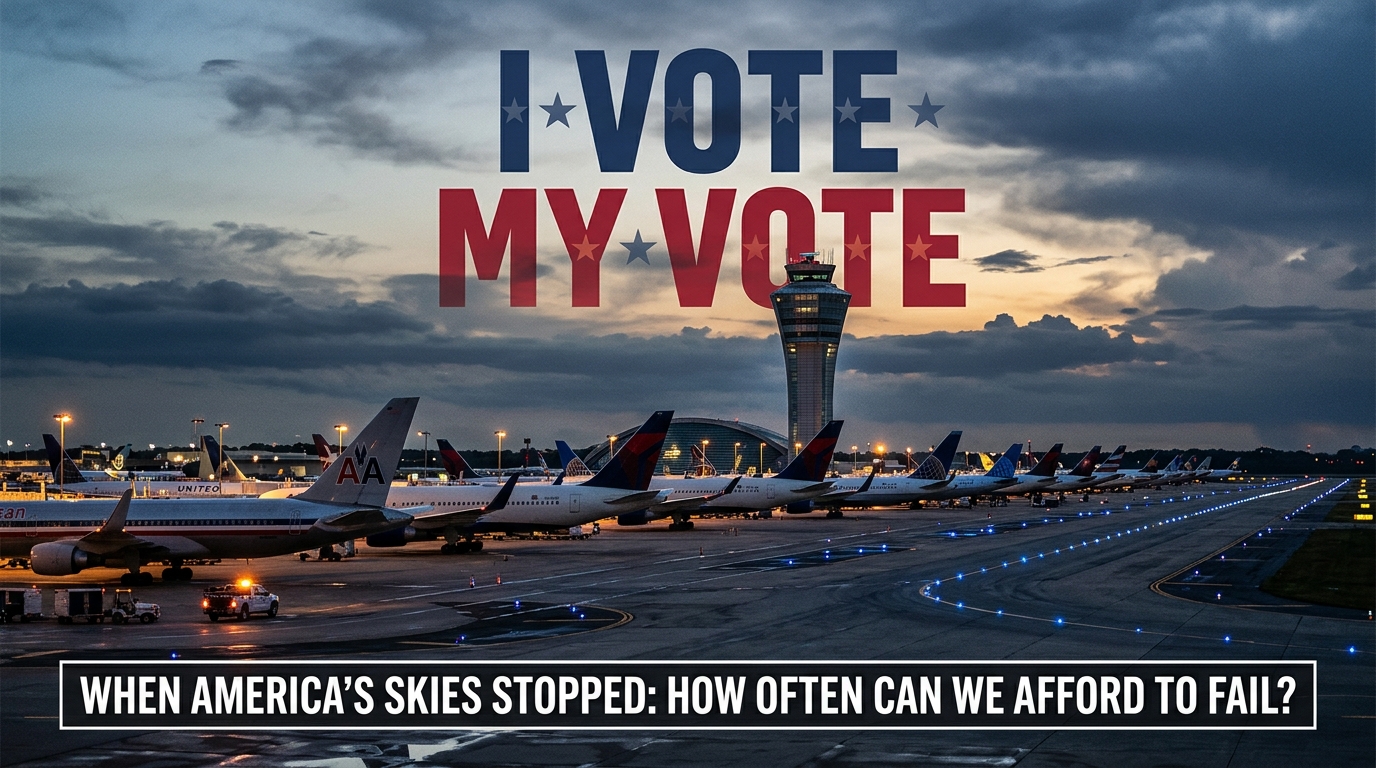
An iVoteMyVote Editorial
November 16, 2026 | Aviation, National Infrastructure & Public Accountability
November 13, 2026: 4 Hours & 20 Minutes of Grounded Airspace
During a fiber-optic telecommunications conversion by federal contractor L3Harris, a network router malfunctioned, generating over 1,000 connection attempts every 4 to 5 seconds. The resulting data cascade blinded air traffic control displays, triggering a nationwide ground stop with more than 3,500 aircraft airborne.
When the Nation’s Air Traffic Came to a Halt
On Friday, November 13, 2026, thousands of Americans preparing to travel discovered that their flights could not depart.
The Federal Aviation Administration (FAA) had issued a nationwide ground stop following a serious telecommunications malfunction affecting air traffic control communications and radar information.
The shutdown lasted approximately four hours and twenty minutes. More than 3,500 aircraft were already airborne when the emergency began, and air traffic controllers and pilots worked tirelessly to guide them safely to their destinations.
Although the ground stop was eventually lifted, its consequences reverberated through the following days. Thousands of flights were canceled or delayed, families were stranded across concourses, critical business appointments were missed, and airlines faced catastrophic operational disruptions.
The incident raises a fundamental question that every American taxpayer deserves to have answered:
How often can our nation afford to experience failures in the essential infrastructure responsible for managing American airspace?
Three Nationwide Ground Stops, but Different Causes
The November 13 interruption was the third major nationwide FAA ground stop since September 11, 2001. However, the three events must be distinguished carefully.
| Date | Cause | Nature of Interruption |
|---|---|---|
| September 11, 2001 | Terrorist attacks | Deliberate national security emergency grounding |
| January 11, 2023 | Corrupted database in the FAA’s NOTAM (flight safety notice) system | Nationwide technical ground stop (under 2 hours) |
| November 13, 2026 | Telecommunications equipment malfunction (L3Harris fiber replacement) | Nationwide technical ground stop (4 hours, 20 minutes) |
The September 11 grounding was a deliberate emergency security measure, not a failure of air traffic control equipment. In stark contrast, the January 2023 and November 2026 interruptions both involved catastrophic breakdowns of essential aviation technology.
These two nationwide technical shutdowns occurred approximately three years and ten months apart. While the 2023 ground stop lasted under two hours, the November 2026 outage lasted more than four hours—paralyzing national transit for more than twice as long.
Are Technical Failures Becoming More Frequent?
Two nationwide technical shutdowns do not, by themselves, establish a statistically increasing failure rate. However, nationwide ground stops are not the only events that deserve examination.
During 2025 and 2026, other FAA systems experienced repeated interruptions, including problems affecting flight safety notices and regional telecommunications networks. Some disruptions were limited to particular facilities or geographic regions; others cascaded into broader operations.
Congress should immediately request a historical review covering at least the past 25 years, identifying:
- The date and duration of each significant aviation interruption.
- The specific system or equipment involved.
- The geographic area and airspace sectors affected.
- The exact number of flights and passengers disrupted.
- The time interval elapsed between comparable failures.
- The age and maintenance records of the equipment involved.
- Whether recommended corrective measures had been completed or delayed.
The American public should not be required to wait for another nationwide shutdown before receiving this transparency.
What Caused the November 13 Failure?
According to the Department of Transportation’s November 14 explanation, the failure occurred during routine work to replace aging copper telecommunications connections with modern fiber-optic technology. The contractor performing the work was L3Harris.
During the conversion, a network router began generating an extraordinary volume of connection attempts—surging to more than 1,000 connection attempts every four to five seconds. This flood overwhelmed adjacent network equipment, severing critical communications and radar information feeds.
Investigators confirmed there was no evidence of a cyberattack. The breakdown occurred during modernization. Modernization is vital, but the procedures and fail-safes used during equipment replacement must be examined with the same rigor as the technology itself.
What Did the Shutdown Cost?
The financial consequences extend far beyond the direct cost of replacing telecommunications hardware. They ripple across every sector of the American economy:
1. The Traveling Public
Passengers incurred immediate out-of-pocket expenses for hotels, meals, ground transportation, additional childcare, and lost business bookings. For example, if one million passengers lost an average of four hours, valued modestly at $25 per hour, the economic loss of time alone reaches:
1,000,000 passengers × 4 hours × $25/hr = $100 Million
2. The Commercial Airlines
Airlines faced immense operational penalties: aircraft and crew repositioning across hub networks, employee overtime, traveler rebooking vouchers, additional jet fuel burn, and lost ticket revenues. At an incremental cost of $10,000 to $20,000 per delayed or canceled flight across 10,000 flights, industry losses range between $100 million and $200 million.
3. Government, Airports & The Wider Economy
Emergency technical response, terminal congestion, overtime ground-handling, along with delayed time-sensitive cargo, medical shipments, and disrupted manufacturing supply chains add tens of millions in unmeasured losses.
The Cost of Failure Versus the Cost of Prevention
Even before a final audited accounting is released, this interruption proves that aviation infrastructure failures impose a staggering national tax on citizens. Those costs must be weighed when Congress debates FAA funding and modernization budgets.
One breakdown does not justify open-ended spending without scrutiny. The decisive metric must be whether an investment measurably enhances system redundancy, eliminates single points of failure, and guarantees reliability.
Accountability Without Political Accusation
The vulnerabilities of America’s air traffic control infrastructure developed over decades, spanning administrations and congresses of both political parties. Partisan finger-pointing will not upgrade legacy switches or restore passenger confidence.
“Accountability identifies what went wrong. Cooperation determines how we make it right.”
Both are indispensable. If federal oversight, contractor execution, or procurement standards fell short, those deficiencies must be made public and remedied immediately.
An Appeal to Congress and the American Voter
At iVoteMyVote.com, we urge Congress to establish a bipartisan, independent panel to investigate recurring aviation control interruptions.
We urge every voter to ask their elected representatives:
“Will you support an independent, publicly understandable accounting of aviation control failures and cooperate across party lines to prevent their recurrence?”
America’s aviation safety must never be degraded into an instrument of partisan politics. The singular mission must be identifying defects, enforcing contractor accountability, and safeguarding the traveling public.
We need cooperation, not accusation; measurable progress, not political promises.
In our companion article, “Rebuilding America’s Air Traffic Control,” we examine aging radar systems, modernization expenditures, national security implications, and congressional responsibilities involved in achieving a lasting solution.
Your vote is your voice. Make it count.