
An IVoteMyVote.com Editorial
By Charlie Theo
November 2026 | Foreign Policy & National Security
The Inspection Blackout: 440 Kilograms of Enriched Uranium
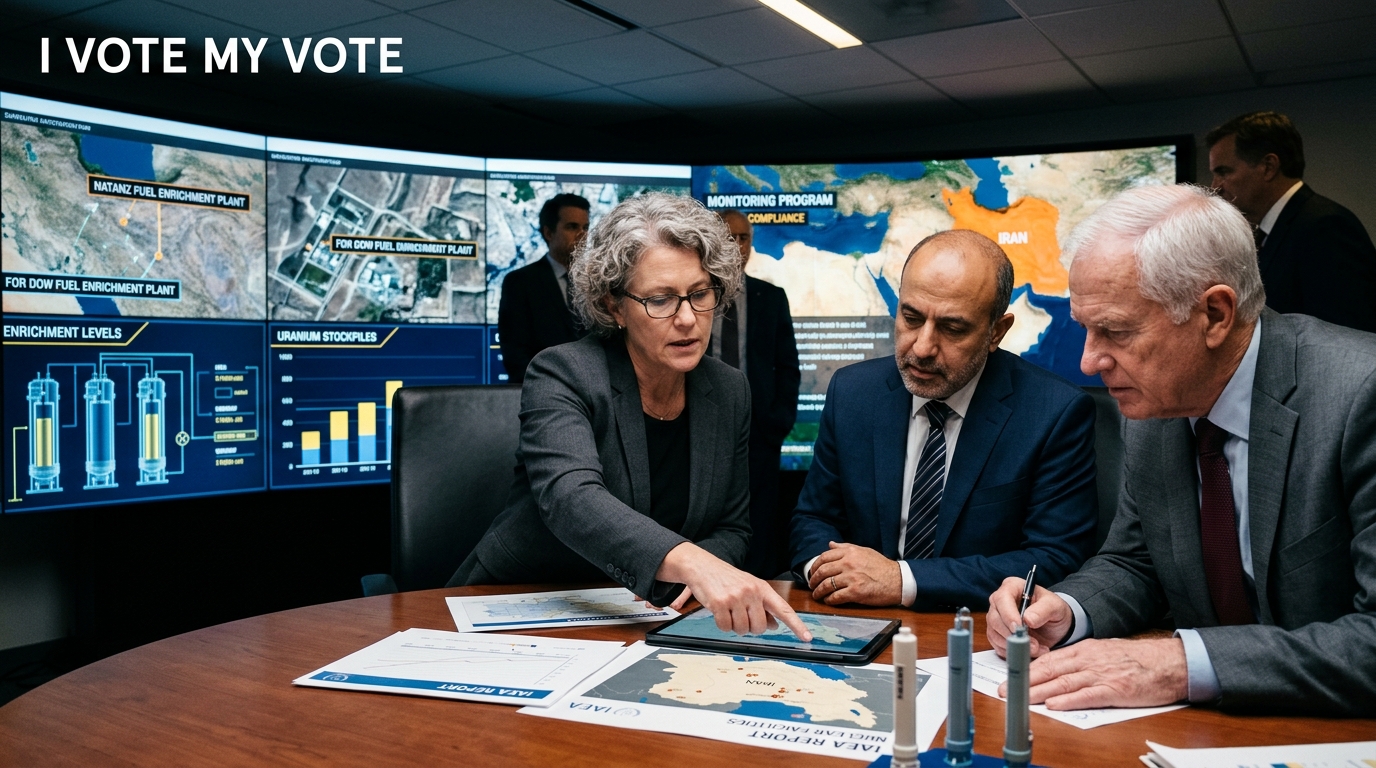
According to the International Atomic Energy Agency (IAEA), Iran’s stockpile stands at approximately 440.9 kilograms (972.02 lbs) of uranium enriched up to 60 percent—just a short technical step from weapons-grade and enough for as many as 10 bombs if weaponized. Without independent on-site verification, the Middle East faces an escalating risk of catastrophic miscalculation.
Does Iran still present a threat of nuclear attack in the Middle East or even elsewhere in the world? This is the persistent and important question that must be answered before any progress can be made in peace talks with the Iranian government.
The very real problem is that no one can get in to Iran to visually inspect and assess their nuclear capabilities. According to the International Atomic Energy Agency, the last estimate puts Iran’s stockpile at 440.9 kilograms (972.02 lbs) of uranium enriched up to 60 percent. This is just a short technical step from weapons-grade and enough for as many as 10 bombs if Iran chose to make weapons of it. That doesn’t mean Iran has a weapon now, but inspectors still can’t verify the locations where hundreds of pounds of this uranium are stored. The Iranian foreign minister has said the material is “under the rubble” of the 2025 strikes, but no outsider can confirm this.
Limited Visibility vs. Rebuilding Operations
There is some limited good news. Rafael Grossi, the Director General of the International Atomic Energy Agency, told the UN Security Council this week that there’s no indication Iran has tried to repair or rebuild the damaged facilities. The Director of US National Intelligence, Tulsi Gabbard, stated in written congressional testimony in March 2026 that Iran made no efforts to rebuild its uranium enrichment capabilities following the June 2025 air strikes.
To make a deliverable weapon, Iran needs the technical capacity to increase the concentration of U-235 in their uranium stocks and a delivery system. The air strikes set all those operations back. But evidence of this rests on limited visibility, and the absence of observation and inspection means that Iran could be enriching their uranium stocks in unknown locations.
The Political Warning Sign: NPT Withdrawal
The bigger worry is the political trajectory. Iran’s nuclear chief said this month that Iran won’t give up enrichment under any circumstances and won’t hand over its stockpile. And, a fast-tracked bill in the Islamic Consultative Assembly to withdraw from the Nuclear Non-Proliferation Treaty is pending.
An Iranian top security official says that while the position against building atomic weapons is unchanged, withdrawal from the treaty remains possible. Withdrawal would be a clear warning sign that Iran intends to build nuclear weapons, because it would remove the last legal and inspection constraints.
Regional Proliferation and the Danger of Miscalculation
Nuclear energy analysts warn that Saudi Arabia is set to acquire American enrichment technology and Turkey wants to follow. Also, the US and Israel have threatened new strikes over suspected construction at a new underground site. Multiple nuclear-capable states in a region with active conflict, short missile flight times, and no communication channels, mean that any miscalculation becomes dangerous.
Breakout Potential vs. Strategic Deterrence
The bottom line at present is that a deliberate nuclear war is unlikely in the near term, since Iran has no confirmed weapon and Israel’s arsenal would deter use. The real danger is a strike, counterstrike, and an exit from the Nuclear Non-Proliferation Treaty by Middle-Eastern member nations in which fear of a nuclear war triggers the very escalation everyone wants to avoid. Restoring inspector access would be a most useful single step to relieve tension in the region.
It is certainly possible to argue that Iran’s unverified stockpile and refusals make a nuclear breakout more imminent than it seems at present, and that more strikes are warranted. Arms-control advocates argue that the air strikes have pushed Iran toward withdrawal from the Non-Proliferation Treaty and that the absence of evidence of rebuilding points to lower near-term risk. Of course, Russia and China are opposed to any further military action against Iran, reflecting the broader disagreement among United Nations members over how to proceed.
The Stance of IVoteMyVote.com
We here at I Vote My Vote believe that it is wise to do all that can be done to destroy Iran’s nuclear weapon production ability because (as we have said before):
“Does anyone with a brain and knowledge of recent history… really believe that they will not use atomic weapons to destroy Israel and conquer the middle east in service to their vicious leaders?”
Or also, does anyone with half a brain believe that Iran would not use a smuggled ‘dirty bomb’ (a small nuclear device) to attack US population centers if they had that capability?
We urge you to become a subscriber to IVoteMyVote.com to help us encourage sanity in our foreign policy towards Iran!
— Charlie Theo, IVoteMyVote.com
Sources & Reference Documentation
- Liechtenstein, S. (2026). IAEA board demands Iran report uranium stocks, grant inspectors access to facilities. Times of Israel. Retrieved from Times of Israel.
- Iran Has Not Rebuilt Nuclear Sites Hit By US-Israel Strikes, Says IAEA Chief Rafael Grossi At UN Security Council Meeting. Free Press Journal. Retrieved from Free Press Journal.
- Iran rejects giving up uranium enrichment, handing over enriched stockpile. Middle East Monitor. Retrieved from Middle East Monitor.
- Hussain, T. (2026). ‘Doing a North Korea’? Why the Middle East could be entering a new nuclear age. South China Morning Post. Retrieved from South China Morning Post.
- Kapper, F. (2026). Iran Hasn’t Rebuilt Nuclear Sites, According To Nuclear Watchdog. The Daily Caller. Retrieved from The Daily Caller.
- Blog: “The lesson from Neville Chamberlain’s fecklessness about ‘peace in our time’ remains unlearned.” (6/30/2026). IVoteMyVote.com.

