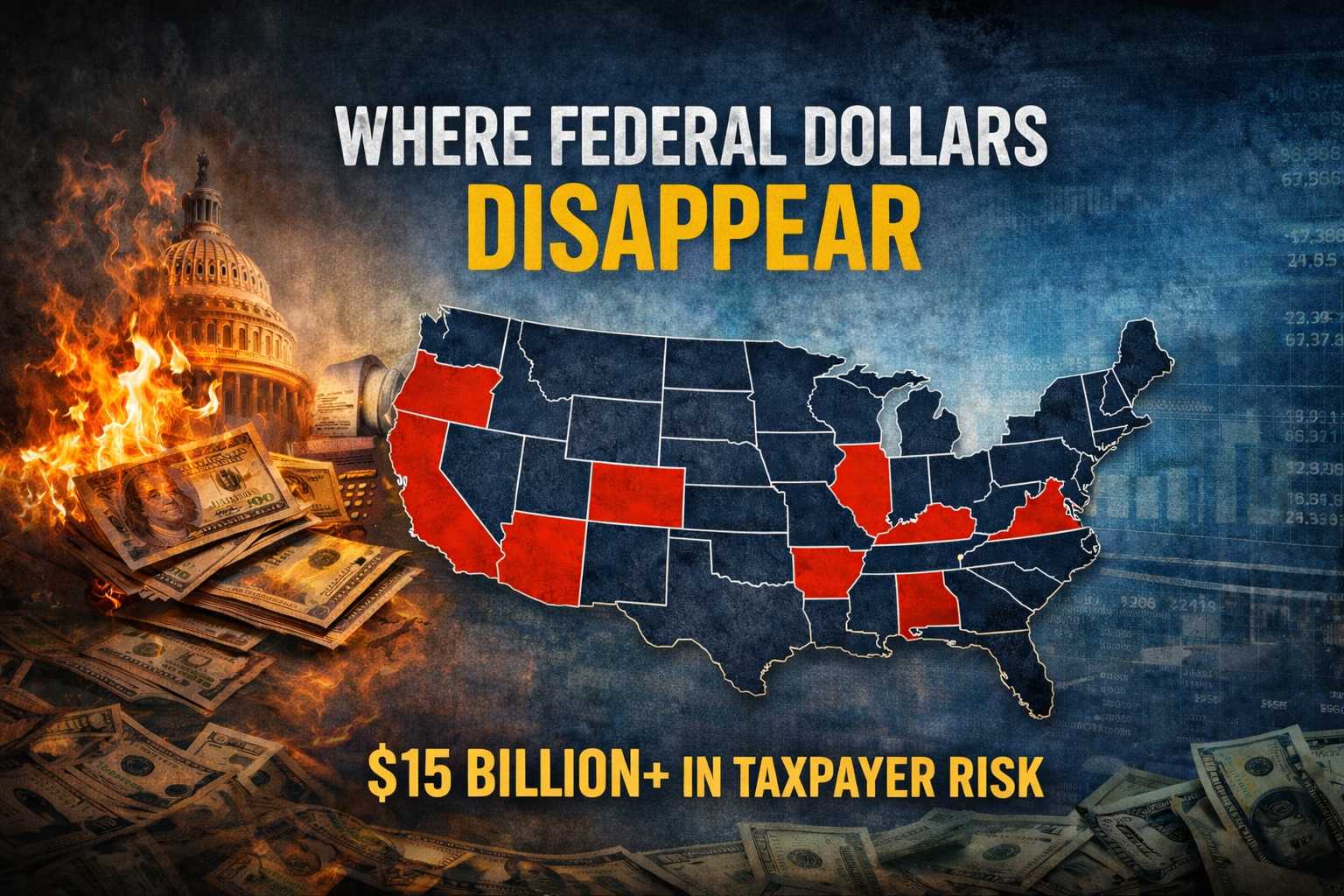
The System Isn’t Leaking It’s Being Drained
Decades ago, William Proxmire warned the nation through his “Golden Fleece Award,” calling out wasteful government spending.
That was a warning.
Today, the issue has evolved far beyond waste.
We are now facing predictable, preventable diversion of federal funds at scale.
Billions of taxpayer dollars are sent to states every year to solve real problems housing, healthcare, infrastructure, disaster recovery. But in too many cases, the system does not verify where that money actually goes.
And when oversight is weak, money doesn’t just drift.
👉 It gets redirected
👉 It gets obscured
👉 It disappears
🚨 Tier 1: High-Risk States for Federal Fund Diversion
This is not about accusation it is about risk environments.
These are states where:
- Oversight systems are inconsistent
- Audit follow-through is weak
- Transparency is limited
- Prior misuse has not resulted in meaningful reform
Below is a working risk breakdown based on known oversight gaps, historical audit concerns, and program complexity.
📊 State-by-State Risk Breakdown (Tier 1)
| State | High-Risk Program Area | Largest Federal Allocation Type | Weak Review Link | Estimated Total Annual Risk Exposure | Estimated Cost Per Taxpayer |
|---|---|---|---|---|---|
| California | Homelessness & Housing | HUD + State Grants | Fragmented city-level oversight | $5B – $10B | $150 – $300 |
| New York | Medicaid & Public Health | Federal Medicaid Funds | Complex billing, delayed audits | $4B – $8B | $120 – $250 |
| Illinois | Pensions & Infrastructure | Federal + State Projects | Politicized contracting oversight | $2B – $5B | $100 – $200 |
| Louisiana | Disaster Relief | FEMA Allocations | Weak post-spending audits | $1B – $3B | $80 – $180 |
| New Mexico | Education Funding | Federal Education Grants | Limited audit resources | $800M – $2B | $70 – $150 |
| Mississippi | Welfare Programs (TANF) | Federal Block Grants | Prior misuse, weak enforcement | $900M – $2B | $90 – $160 |
| Alaska | Energy & Infrastructure | Federal Infrastructure Funds | Low transparency, geographic spread | $700M – $1.5B | $60 – $140 |
| West Virginia | Opioid & Health Funding | Federal Health Programs | Multi-agency oversight gaps | $900M – $2B | $75 – $155 |
📊 Tier 1 Combined Risk Summary
| Category | Estimated Range |
|---|---|
| Total Annual Risk Exposure (Tier 1 States) | $15B – $33.5B |
| Average Cost Per U.S. Taxpayer | $110 – $220 annually |
These figures represent estimated risk exposure based on program size, historical audit findings, and known oversight gaps not confirmed fraud totals. The purpose is to identify where weak controls create the highest potential for misuse.
💥 What This Really Means
Even a 5–10% diversion within these ranges represents billions lost.
Money that was meant to:
- House families
- Treat patients
- Rebuild communities
- Strengthen infrastructure
Instead risks being consumed by inefficiency, mismanagement, or worse intentional misuse.
At the high end, this exposure approaches $30+ billion annually.
That is not a rounding error.
That is a systemic vulnerability.
🔍 The Pattern Behind the Problem
Across high-risk states, the same breakdown appears:
⚠️ Money Moves Faster Than Oversight
Large federal funding flows quickly review systems lag behind.
⚠️ Fragmented Accountability
State, county, and city layers create gaps where responsibility is unclear.
⚠️ Weak Consequences
Audit findings exist but enforcement is delayed or diluted.
⚠️ Complexity Masks Misuse
Programs like Medicaid and housing involve multiple layers, vendors, and billing systems making diversion easier to hide.
👤 Why This Matters to You
This is not abstract.
If you pay federal taxes, you are funding these programs.
When funds are diverted:
- Services don’t improve
- Problems repeat
- Costs return to taxpayers again and again
👉 Through higher taxes
👉 Through reduced outcomes
👉 Through repeated funding cycles
🔧 What Must Change
High-risk environments require immediate structural correction:
- Independent, non-political audit authorities
- Real-time public transparency dashboards
- Federal and state cross-verification systems
- Automatic enforcement when misuse is identified
Without these, the cycle continues.
⚖️ Final Reality
Fraud rarely begins as theft.
It begins with:
👉 Weak oversight
👉 Limited transparency
👉 No consequences
And over time, it becomes expected.
Ignoring high-risk systems does not solve the problem.
It allows it to grow.
📣 Take Action
Ask your representatives:
- Where is federal money tracked publicly?
- Who verifies how it is used?
- What happens when misuse is found?
Demand answers. Demand transparency. Demand accountability.
Because every dollar lost is not just wasted –
It is a solution that never reached the people it was meant to help.