Written by Claude Tatro, with analytical and language support from Elder (ChatGPT).
Introduction
The growing conflict involving the Islamic Republic of Iran, the State of Israel, and the United States of America is not simply a military contest between governments. It is also a struggle involving economic survival, political power, energy control, military deterrence, and the lives of millions of civilians caught between hardened leadership positions.
The world often focuses on missiles, air strikes, naval deployments, uranium enrichment, and military retaliation. However, behind every military decision lies another battlefield that receives less attention: the economic destruction imposed upon civilian populations.
The current trajectory suggests a conflict where neither side wishes to appear weak, neither side fully trusts the other, and all sides are attempting to pressure the other into submission without triggering uncontrollable regional collapse.
At the same time, ordinary citizens throughout Iran, Israel, and allied nations may ultimately bear the greatest burden.
The Strategic Goals of Iran
The leadership structure of the Islamic Republic of Iran has long viewed uranium enrichment and military capability as essential tools for regime survival.
From the Iranian perspective, surrendering uranium capabilities completely to the United States could be interpreted internally as surrendering national sovereignty itself.
Iranian leadership likely believes several realities:
- That external powers ultimately seek regime change.
- That military weakness invites foreign intervention.
- That nuclear capability or near-capability provides deterrence.
- That surrendering strategic leverage may threaten the survival of those currently in power.
This does not necessarily mean all Iranian citizens support confrontation.
Like populations in many nations, civilians often possess a range of opinions while having limited control over the strategic decisions of governments, militaries, intelligence organizations, or religious authorities.
Israeli Security Calculations
The government of Israel views a nuclear-capable Iran as an existential threat.
Israel’s geographic size and population density create unique security fears. Israeli leadership has historically emphasized preemptive defense, intelligence penetration, missile defense systems, and rapid military action when potential existential threats emerge.
From the Israeli perspective:
- Iranian-backed regional proxy groups create ongoing military pressure.
- Missile capability combined with uranium enrichment creates unacceptable risk.
- Delay may increase the danger of future confrontation.
- Strategic ambiguity can become fatal if adversaries gain irreversible capability.
This perspective drives military planning focused upon disruption of Iranian military infrastructure, uranium processing capability, weapons research, command systems, and regional force projection.
The Role of the United States
The United States occupies multiple positions simultaneously:
- Strategic military ally of Israel.
- Naval protector of international shipping routes.
- Major global energy influence.
- Diplomatic actor attempting to prevent nuclear proliferation.
- Economic superpower capable of imposing severe sanctions.
American leadership must also weigh domestic political pressure, alliance commitments, global energy markets, election consequences, and military risk.
Direct military conflict with Iran presents serious challenges even for the United States military.
Iran possesses:
- Large missile inventories.
- Regional proxy influence.
- Naval disruption capability.
- Geographic advantages in the Persian Gulf.
- The ability to threaten oil shipping routes.
Because of these realities, economic warfare and naval pressure often become preferred methods of coercion before large-scale ground war.
Iranian Naval Mine Warfare and International Waters
One of the most dangerous escalation scenarios involves the mining of international shipping lanes.
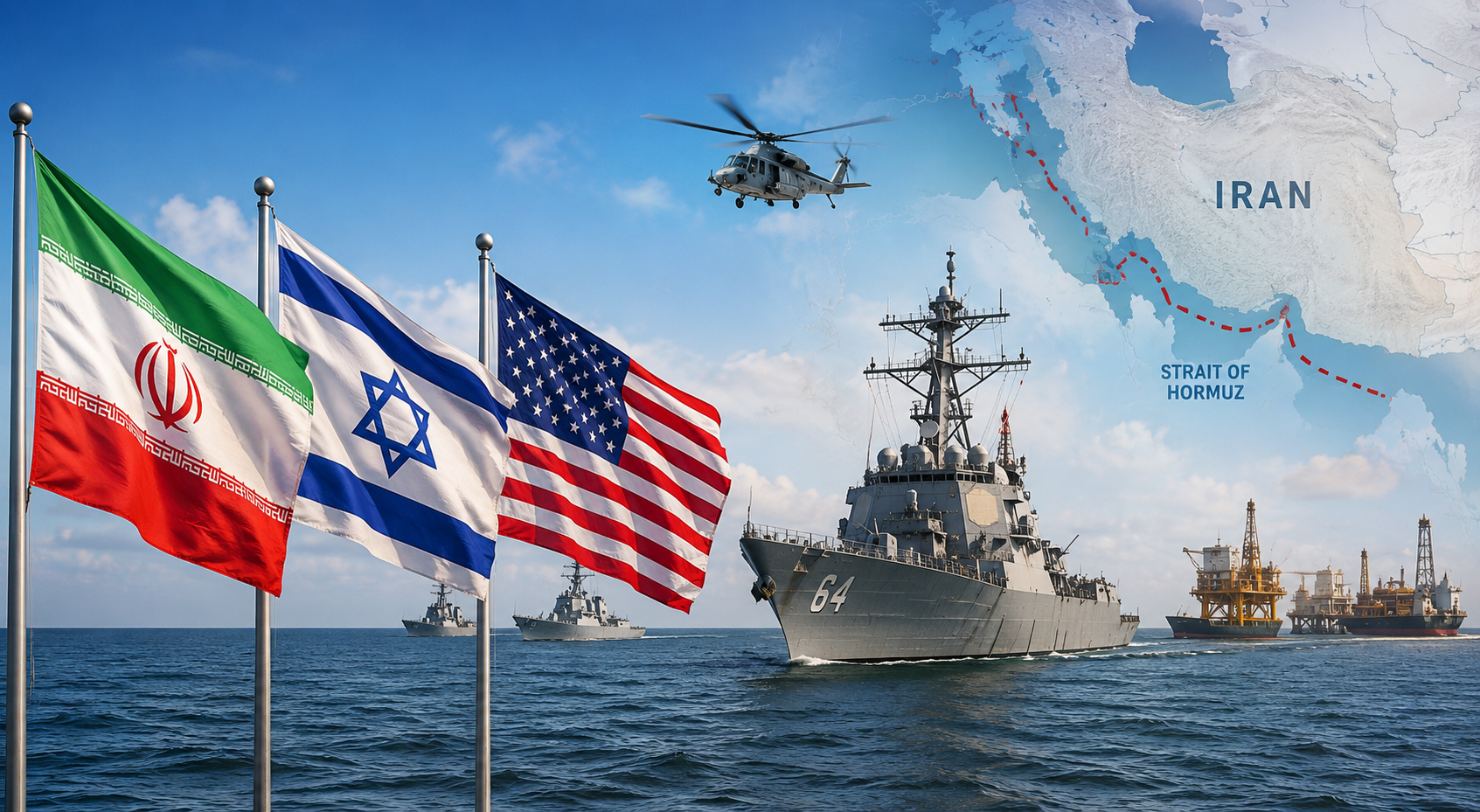
If Iran deploys naval mines within or near strategic waterways such as the Strait of Hormuz, the consequences could rapidly affect the global economy.
The Strait of Hormuz remains one of the most strategically important energy transit routes on Earth.
A significant percentage of global oil shipments pass through this narrow maritime corridor.
Mining operations could:
- Threaten commercial shipping.
- Raise global energy prices.
- Interrupt international trade.
- Force multinational naval responses.
- Increase the likelihood of direct naval combat.
The United States Navy and allied forces would almost certainly attempt mine-clearing operations while establishing military control over shipping access.
This could evolve into an effective naval blockade environment where Iranian export capability becomes severely restricted.
Naval Blockade and Economic Pressure
Economic warfare can become more devastating than direct bombing.
A sustained naval blockade or severe restriction of Iranian oil exports could dramatically reduce the nation’s primary revenue stream.
Oil revenue supports:
- Government operations.
- Military funding.
- Infrastructure maintenance.
- Currency stability.
- Food imports.
- Public sector wages.
If export capability collapses, internal economic strain could intensify rapidly.
Inflation, shortages, unemployment, and currency instability may severely impact ordinary civilians long before political leadership changes.
History repeatedly demonstrates that sanctions and economic warfare often hurt populations faster than ruling structures.
Damage to Oil Infrastructure and Well Capping Risks
If military operations target Iranian oil production facilities, ports, refineries, pipelines, or offshore systems, the consequences may extend beyond temporary disruption.
Severe infrastructure damage can create long-term production collapse.
In extreme scenarios, damaged wells may require emergency capping operations to prevent:
- Massive oil loss.
- Environmental contamination.
- Fires.
- Long-term reservoir damage.
Such damage can take years to repair.
Even if military operations eventually stop, oil production recovery may remain limited for extended periods.
This could create prolonged economic punishment affecting generations of civilians rather than only military leadership.
The destruction of economic infrastructure often becomes a hidden long-term casualty of modern warfare.
The Civilian Population Becomes the Pressure Point
Modern geopolitical conflict increasingly targets systems rather than armies alone.
Energy systems.
Financial systems.
Supply chains.
Ports.
Communications.
Transportation.
The result is that civilian populations frequently become the pressure point through which governments attempt to force political concessions.
The international community must recognize that prolonged economic collapse inside Iran could produce:
- Mass poverty.
- Internal unrest.
- Refugee pressures.
- Humanitarian instability.
- Increased extremism.
- Regional destabilization.
Economic punishment rarely remains neatly contained within national borders.
The Reality of Leadership Survival
The IVMV approach attempts to acknowledge uncomfortable realities rather than simply repeating slogans.
Governments facing existential pressure rarely surrender power voluntarily.
Leadership groups that believe their removal could result in imprisonment, assassination, revolution, or regime collapse are unlikely to easily concede strategic leverage.
Therefore, demands for complete immediate surrender of uranium capability without parallel security guarantees may be viewed by Iranian leadership as politically impossible.
At the same time, the United States and Israel may view unrestricted uranium advancement as strategically unacceptable.
This creates a dangerous stalemate:
- Iran believes uranium capability protects regime survival.
- Israel believes Iranian capability threatens national survival.
- The United States attempts to prevent nuclear escalation while maintaining regional influence.
Each side therefore views compromise as potentially dangerous.
The IVMV Perspective
The iVoteMyVote approach encourages citizens to examine both the strategic realities and the human consequences simultaneously.
A serious peace framework would likely require:
- Verified international monitoring.
- Gradual reciprocal concessions.
- Regional security guarantees.
- Economic incentives tied to compliance.
- Protection against immediate regime-collapse exploitation.
- Clear enforcement mechanisms.
However, such frameworks require political courage and mutual distrust remains extraordinarily high.
IVMV also recognizes that populations themselves must pressure governments toward realistic outcomes.
Citizens must ask difficult questions:
- What level of risk is acceptable?
- How many civilians may suffer economically?
- What military actions increase global instability?
- What outcomes actually improve long-term peace?
- Which policies strengthen ordinary people versus strengthening endless conflict?
Military Victory Versus Strategic Stability
History shows that military superiority alone does not always create stable peace.
Wars may destroy infrastructure faster than they build trust.
Economic collapse may weaken societies while simultaneously strengthening radicalization.
Naval blockades may pressure governments while also intensifying humanitarian suffering.
A temporary battlefield victory can evolve into decades of instability if the underlying political realities remain unresolved.
Conclusion
The conflict involving Iran, Israel, and the United States represents more than a regional confrontation.
It is a test of whether modern powers can balance security concerns, military capability, economic pressure, civilian survival, and long-term stability without triggering uncontrollable escalation.
The mining of international waterways, naval blockades, attacks upon oil infrastructure, and uranium disputes each carry consequences extending far beyond the battlefield.
The world must understand that wars are not fought only with bombs and missiles.
They are also fought through currencies, shipping lanes, sanctions, oil production, and the daily suffering of civilians attempting to survive beneath geopolitical struggles they did not personally create.