The negotiations unfolding between Washington and Tehran represent one of the most complex diplomatic efforts of the 21st century. After a U.S.-Israeli military campaign that began in February 2026, a shaky ceasefire brokered by Pakistan, and rounds of talks in Geneva, Islamabad, and back-channel relays through Qatar, both sides are inching toward a memorandum of understanding. But for all the diplomatic energy being poured into warhead counts and oil tanker transit rights, one fundamental issue is being left entirely off the table: the right of the Iranian people to govern themselves.
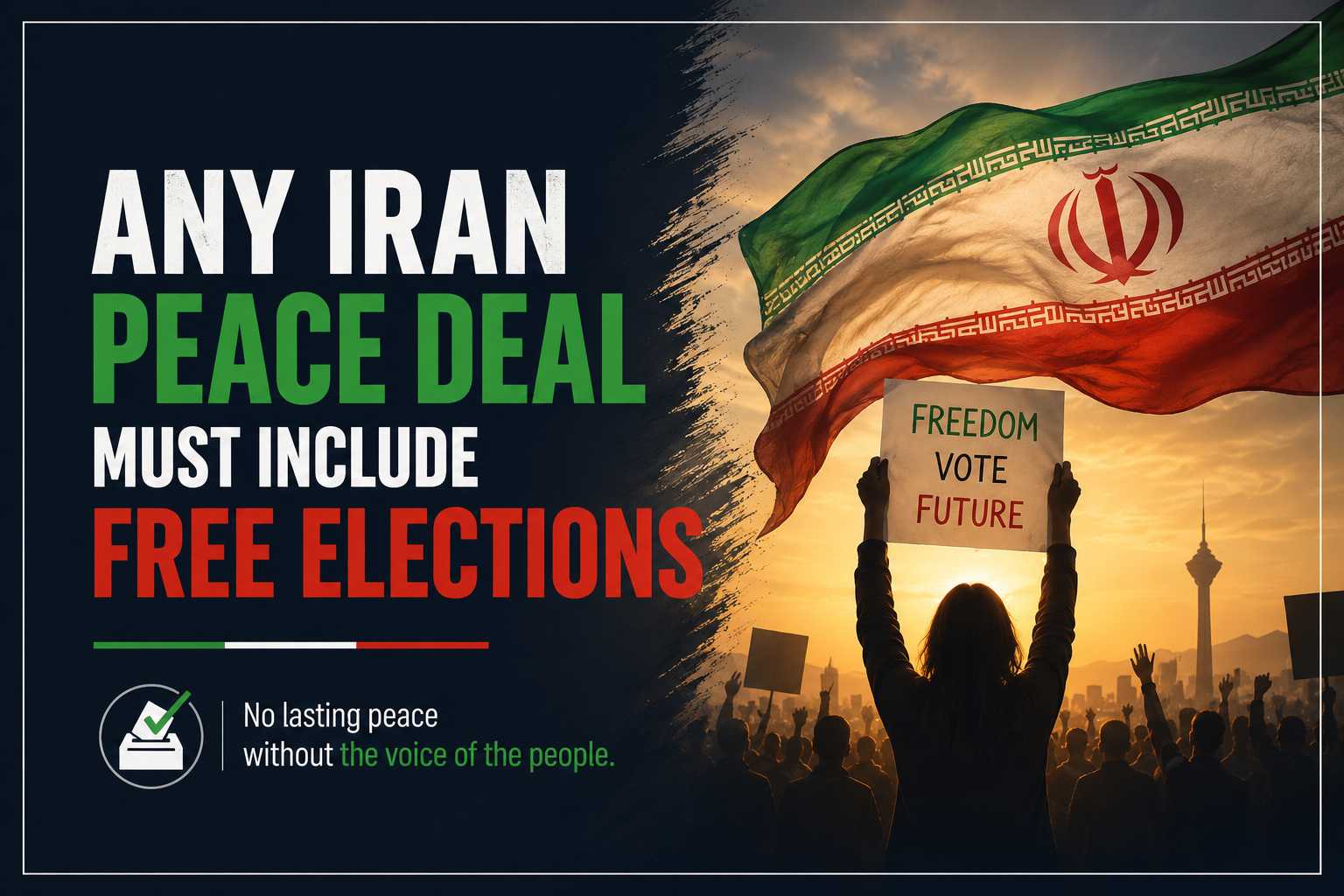
At I Vote My Vote, voting is our purpose. We believe that self-governance — genuine, contested, internationally monitored elections — is not a Western imposition or a luxury reserved for peace. It is the foundation upon which lasting peace is built. And any agreement that ignores this foundation is not a peace deal. It is a pause.
What the Current Deal Looks Like
As of June 2026, the draft memorandum of understanding on the table includes a 60-day extension of the ceasefire, the reopening of the Strait of Hormuz in exchange for a partial lifting of the U.S. naval blockade, a commitment from Iran to negotiate over its nuclear enrichment program during the ceasefire window, and the release of frozen Iranian assets. These are meaningful provisions. But they are transactional, not transformational.
Iran’s Guardian Council — an unelected body of hard-line conservatives — disqualifies candidates it deems insufficiently loyal to the clerical establishment before they can ever reach the ballot. For decades, ultimate power rested not with voters, but with the Supreme Leader and the unelected institutions under his control, including the security forces and judiciary that suppress dissent. These institutions are the architecture of the problem. No deal that leaves them intact solves anything durable.
“A peace agreement that leaves the Iranian people without a voice is not peace. It is a truce between governments, signed over the heads of the governed.”
A Leadership Born of War, Not the Ballot
The case for free elections has only grown more urgent in recent months. On February 28, 2026, Iran’s longtime Supreme Leader, Ayatollah Ali Khamenei — who was 86 — was killed in a joint U.S.-Israeli airstrike on his Tehran residence, along with several members of his family and dozens of senior Iranian officials. His death threw the Islamic Republic into an unprecedented succession crisis.
What followed was not an election in any meaningful sense. On March 8, 2026, the Assembly of Experts elevated Khamenei’s son, Mojtaba Khamenei — then 56 — to the position of Supreme Leader. He himself was wounded in the same strike that killed his father, and he then vanished from public view for an extended period, fueling widespread confusion over his own condition. Iranian state media has referred to him using a term ordinarily reserved for disabled war veterans.
So today, Iran is governed by an unelected successor — reportedly more hardline than his father — who inherited absolute power through a closed clerical process, in the middle of a war, with no public mandate whatsoever. If there was ever a moment that exposed the hollowness of Iran’s electoral facade, this is it. A nation of nearly 90 million people had no say in who would lead them. That is precisely the vacuum in which the international community has the most leverage — and the most responsibility — to insist on a different path.
The Case for the Surrender of Bomb-Grade Uranium
On the nuclear question, the current negotiations require Iran to commit to never pursuing nuclear weapons and to negotiate a suspension of its uranium enrichment program. Iran has agreed in principle to the spirit of this commitment — but has resisted the U.S. demand to physically ship its stockpile of highly enriched uranium out of the country.
This is a critical distinction. A promise to enrich less is one thing. The removal of existing stockpiles of bomb-grade uranium — material already enriched to levels far beyond what any civilian energy program requires — is an entirely different and far more verifiable commitment. Inspectors can count centrifuges. It is much harder to track uranium once it exists in quantity. A deal that leaves bomb-grade material inside Iran’s borders asks the world to trust a government that spent years secretly expanding its nuclear infrastructure.
Our position on nuclear terms: Any lasting agreement must require the complete physical surrender and verified international removal of all highly enriched, bomb-capable uranium stockpiles — not merely a pledge to halt future enrichment. Verification must be unconditional and continuous, conducted by the International Atomic Energy Agency without prior notice or restriction.
The Strait of Hormuz: A Global Artery, Not a Bargaining Chip
Roughly 20 percent of the world’s oil and a significant share of global liquefied natural gas passes through the Strait of Hormuz. Iran’s closure of the strait — or the threat of it — has rippled through every economy on earth, raising energy costs, stoking inflation, and compressing the budgets of households who have no stake in this conflict. The strait must be permanently and unconditionally open to international shipping. It cannot be treated as a concession to be toggled on or off depending on the political temperature in Tehran.
The current draft reportedly includes provisions for Hormuz’s reopening in exchange for the lifting of the U.S. naval blockade. We support this exchange — but with a firm condition: freedom of navigation through the strait must be codified in any final agreement as a permanent and non-negotiable term, not a 60-day courtesy while negotiations proceed.
Other Contingencies That Must Be on the Table
A comprehensive peace framework requires more than nuclear concessions and shipping guarantees. We believe the following provisions must also be incorporated into any lasting agreement:
1. Free, Internationally Monitored Elections. Iran must commit to holding elections that meet international democratic standards — including the removal of the Guardian Council’s power to disqualify candidates on ideological grounds — within a defined transition period verified by international observers.
2. Full Surrender of Bomb-Grade Uranium. All highly enriched uranium stockpiles must be physically removed from Iranian territory and placed under international custody, with continuous IAEA verification and no restriction on inspection access.
3. Permanent, Unconditional Opening of the Strait of Hormuz. Freedom of navigation through the strait must be codified as a permanent, non-negotiable term — not a ceasefire benefit that expires with the next round of talks.
4. Disarmament and Defunding of Proxy Forces. Iran must verifiably end material support — weapons, financing, and training — to Hezbollah, Hamas, and other armed non-state actors across the region, in line with existing UN Security Council resolutions.
5. Release of Political Prisoners. As a precondition for sanctions relief, Iran must release all political prisoners detained for peaceful protest, journalism, or expression — including those imprisoned in the crackdowns following the December 2025 demonstrations.
6. Transparent Reconstruction Mechanisms. Any release of frozen Iranian assets must be tied to verified civilian reconstruction — not military or paramilitary reconstitution — with international financial monitoring.
7. A Path for Civil Society. The agreement should include provisions protecting the right to organize, protest, and operate non-governmental organizations — establishing the conditions under which genuine democratic transition becomes possible.
Why Democracy Is the Missing Clause
Beginning in late December 2025, protests swept all 31 of Iran’s provinces — driven by soaring inflation, a collapsing currency, and decades of economic mismanagement compounded by sanctions. These were not fringe demonstrations. They included merchants, students, and citizens from communities historically loyal to the state. The Iranian people, in other words, are not the same as the Iranian government.
A deal signed between Washington and Tehran that restores the regime’s economic lifeline — without creating any mechanism for accountability to Iranian citizens — does not serve the Iranian people. It serves the Iranian government. And history is unambiguous on what governments unchecked by their own people tend to do with that breathing room.
“The protesters in Tehran’s streets in December 2025 were not asking for a nuclear deal. They were asking for the same thing voters everywhere ask for: a say in their own future.”
With an unelected successor now installed and the country’s power structure in flux, Iran is already entering a period of potential political transformation. A peace agreement that locks in the existing arrangement — without any democratic opening — misses a generational window. One that requires a path to free elections gives the Iranian people something durable: a mechanism to hold whatever government follows accountable.
The American Interest in Iranian Democracy
Some will argue that insisting on democratic reform is overreach — that the U.S. has no business dictating another country’s internal governance. But this argument confuses imposition with condition. We are not suggesting the United States choose Iran’s government. We are suggesting that sanctions relief, the lifting of blockades, and the release of frozen assets — all of which benefit the Iranian government enormously — be conditioned on that government creating a genuine path for its own citizens to exercise the vote.
Democracies are not perfect. But they are statistically far less likely to wage aggressive war, close international shipping lanes, or fund proxy armies across the region than governments that answer to no one. An Iran with free elections is a fundamentally different strategic partner than an Iran governed by an unaccountable clerical establishment. American interests are served by the former, not merely by a ceasefire that preserves the latter.
A Message to American Voters
Congress is already reacting to these peace talks — with leaders focused on gas prices, and senators on both sides raising concerns about oversight, verification, and the risk of a deal that repeats the mistakes of the 2015 nuclear agreement. These are legitimate debates. But the debate that is not happening — the one about whether any deal includes a democratic future for the Iranian people — is the one that matters most for long-term stability.
As American voters head toward November’s midterms, this is an issue you can raise: ask your representative and your senator whether they are pushing for free elections to be part of any Iran peace framework. Ask whether bomb-grade uranium will be physically removed, not just promised away. Ask whether the strait will be permanently open or merely conditionally cracked. These are the questions that separate a durable peace from a diplomatic photo opportunity.
This is our core belief: The right to vote — to choose the people who govern you, to remove them when they fail you, to hold power accountable through the ballot — is not a Western value. It is a human value. A peace agreement that ignores it is incomplete. We believe it can, and must, be better.
I Vote My Vote is a nonpartisan civic engagement platform dedicated to voter education and transparent coverage of U.S. elections. We do not endorse candidates or parties. Reporting in this article draws on coverage from the U.K. House of Commons Library, CBS News, Axios, Al Jazeera, CNN, Freedom House, and other public sources documenting the 2026 U.S.-Iran negotiations and Iranian leadership crisis.
Subscribe to I Vote My Vote for weekly election coverage, candidate profiles, and civic commentary delivered straight to your inbox.
Your vote and your voice matter. Join www.ivotemyvote.com Now