When Disaster Strikes, Who Shows Up?
Every nation has flaws.
Every nation has moments of greatness.
Today’s public conversation often emphasizes America’s mistakes—wars, political divisions, racial conflict, economic inequality, or diplomatic disagreements. Democracies should examine their own shortcomings honestly. Self-examination is one of the strengths of a free society.
But an informed citizen should also examine another question.
When catastrophe strikes somewhere in the world, which nations consistently respond?
The historical record deserves attention.
Humanitarian Leadership Is Not Always in the Headlines
When earthquakes destroy cities…
When tsunamis erase villages…
When hurricanes devastate islands…
When famine threatens millions…
When epidemics spread…
When refugees flee war…
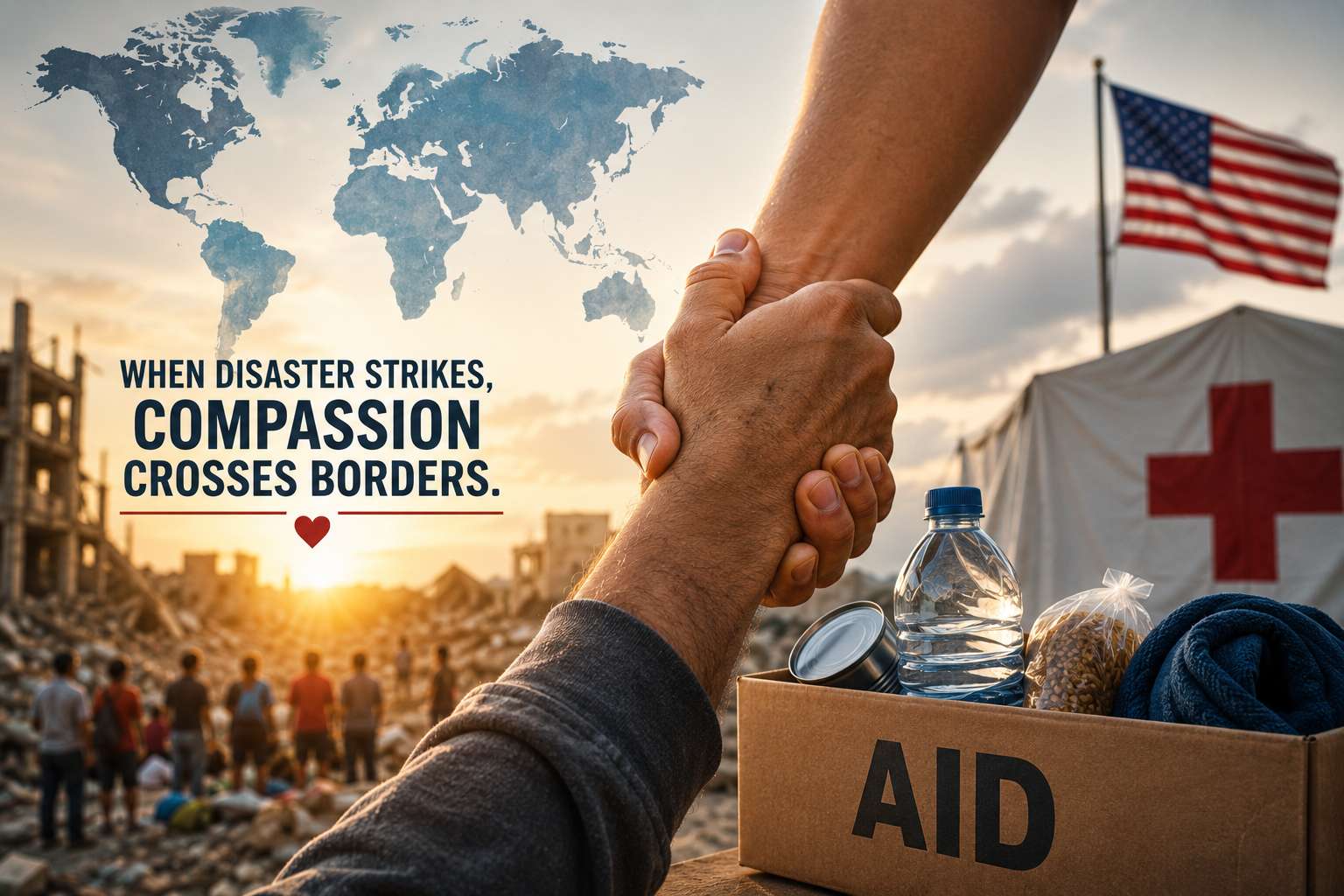
The United States has repeatedly been among the first nations to provide assistance.
This help comes in many forms:
- emergency food
- medical supplies
- search-and-rescue teams
- military airlift capability
- hospital ships
- engineering units
- temporary shelters
- financial assistance
- water purification systems
- reconstruction funding
Often, this assistance begins within hours.
Government Is Only Part of the Story
Many Americans assume disaster relief comes entirely from Washington.
It does not.
America’s generosity comes from many directions.
Federal agencies provide immediate emergency assistance.
Military forces transport equipment and personnel that many countries simply cannot move on their own.
State governments frequently send emergency specialists.
American corporations donate millions of dollars in equipment and supplies.
Universities contribute research and medical expertise.
Churches organize volunteers.
Private charities raise enormous sums.
Individual citizens quietly mail checks, donate blood, and volunteer their time.
Much of this occurs without political recognition.
A Tradition of Private Giving
One characteristic that distinguishes the United States is its long tradition of private charitable giving.
Americans donate hundreds of billions of dollars annually to charitable organizations.
Many donations never make national news because they occur quietly through:
- local churches
- community organizations
- civic clubs
- disaster relief organizations
- hospitals
- volunteer groups
- neighborhood fundraisers
These acts are not directed by government.
They are expressions of individual compassion.
Disaster Relief Around the World
Consider only a few examples over recent decades.
American assistance has supported victims after:
• the Indian Ocean tsunami
• earthquakes in Haiti, Türkiye, Nepal, Pakistan, Japan, and elsewhere
• hurricanes throughout the Caribbean
• African famine relief
• refugee crises across Europe and the Middle East
• global responses to disease outbreaks
• humanitarian assistance following conflicts around the world
In many of these events, American military aircraft, naval vessels, and logistics specialists delivered aid where civilian transportation simply could not.
The World’s Largest Emergency Logistics Network
One reality is often overlooked.
Possessing the ability to help is different from wanting to help.
The United States maintains one of the world’s largest transportation and logistics systems.
Large cargo aircraft.
Hospital ships.
Naval transport.
Heavy helicopters.
Engineering units.
Medical teams.
These resources were built primarily for national defense.
Yet they have repeatedly become invaluable tools for humanitarian missions.
Very few nations possess comparable capabilities.
Americans Rarely Ask Who Receives the Help
When disasters occur, relief organizations generally do not ask:
“What political party do you support?”
“What religion do you practice?”
“What country are you from?”
“What race are you?”
Instead, they ask:
“Who needs help?”
That principle reflects one of humanity’s finest qualities.
Recognizing Imperfection Without Ignoring Good
Acknowledging America’s humanitarian record does not require believing America has been perfect.
No nation has been.
History contains military mistakes.
Foreign policy errors.
Domestic injustices.
Political disagreements.
These deserve honest examination.
But fairness also requires recognizing the enormous good accomplished by millions of Americans whose names are never known.
Teachers who volunteer.
Doctors who travel overseas.
Engineers who rebuild bridges.
Military personnel delivering food.
Pilots flying medical supplies.
Church groups rebuilding homes.
Neighbors helping strangers.
These stories are also part of America’s history.
What Should Voters Learn?
Citizens should resist two extremes.
One extreme insists America can do no wrong.
The other insists America has done little right.
Neither position reflects reality.
Informed voters should examine evidence rather than slogans.
Patriotism should never require ignoring mistakes.
Criticism should never require ignoring accomplishments.
A mature democracy is capable of both honesty and gratitude.
Final Thought
Perhaps the measure of a nation is not whether it has made mistakes.
Every nation has.
Perhaps the better question is this:
When others suffer, does that nation help?
For generations, millions of Americans—through government, charities, churches, businesses, and individual acts of generosity—have answered that question with action rather than words.
That record deserves to be remembered.
Not as a reason for arrogance.
But as a reason to continue striving to be a nation that extends a helping hand whenever and wherever it is needed.
✔️ IVMV Citizen Action
An informed voter should evaluate nations, leaders, and policies with balance rather than emotion. Celebrate genuine accomplishments. Acknowledge real failures. Resist simplistic narratives that portray any country as entirely heroic or entirely shameful.
Democracy is strengthened when citizens judge history honestly, appreciate the quiet acts of compassion that often go unnoticed, and encourage future leaders to preserve America’s long tradition of humanitarian service at home and abroad.