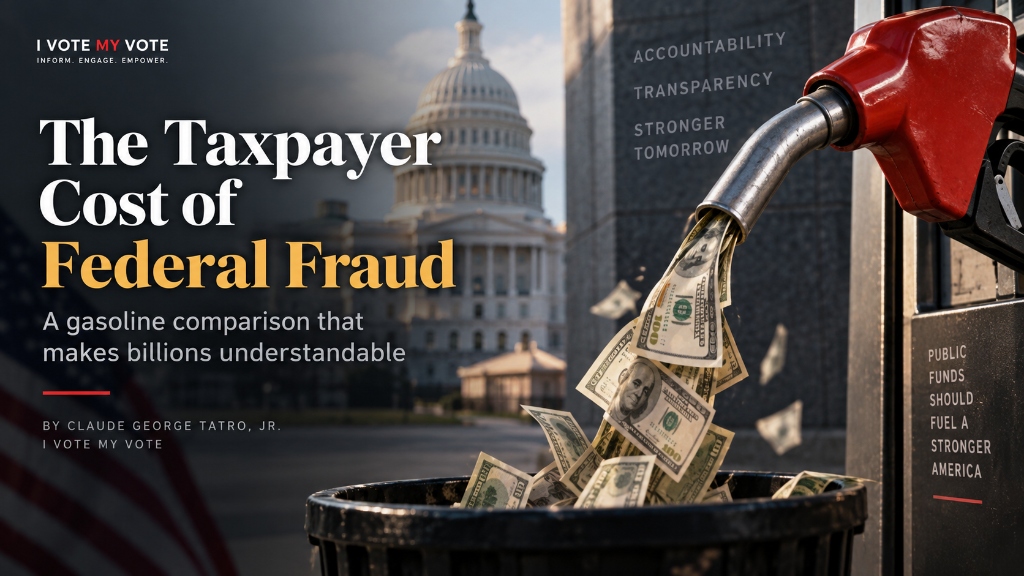
A gasoline comparison that makes billions understandable
By Claude George Tatro, Jr. | I Vote My Vote
$500 Billion ≈ $3.66 for Every Gallon
At an illustrative $3.50/gallon, $500 billion in annual fraud is roughly equivalent to the nation’s entire annual motor gasoline bill across the United States.
We notice when gasoline rises a few cents a gallon. We should bring that same attention to public money lost to fraud. Money diverted through deception leaves taxpayers financing expenditures that fail to serve their intended public purpose. Preventing those losses would preserve resources for legitimate needs or reduce the amount government must raise or borrow.
Putting the Cost in Gallons
The U.S. Energy Information Administration (EIA) reports that Americans consumed approximately 136.53 billion gallons of motor gasoline in 2025. Dividing a hypothetical annual fraud saving by those gallons gives us a familiar measure of its purchasing power [1].
| Illustrative Annual Savings | Equivalent per Gallon | Equivalent per 15 Gallons |
|---|---|---|
| $225 billion | $1.65 | $24.72 |
| $500 billion | $3.66 | $54.93 |
The calculation is annual savings divided by annual gallons consumed. At an illustrative gasoline price of $3.50 per gallon, the nation’s annual motor gasoline bill would be approximately $478 billion. A $500 billion saving would exceed that entire bill.
This comparison does not propose free gasoline or predict lower pump prices. It shows the scale of public resources at stake. It also does not describe an individual taxpayer’s share of fraud losses; tax payments and gasoline use vary widely.
What the Fraud Estimates Actually Mean
The Government Accountability Office (GAO) estimated annual federal fraud losses of $233 billion to $521 billion using data from fiscal years 2018 through 2022. GAO continued to cite that range in 2026. It is an estimate based on an earlier period that included the pandemic, not a verified loss total for 2025 or 2026 [2].
Our $225 billion and $500 billion figures are illustrative scenarios. The first is below the lower end of GAO’s range; the second is near its upper end. Neither is a promise that government can recover or prevent that amount every year. Effective controls and investigations cost money, and actual net savings must be measured after those costs.
We must also distinguish fraud, which involves intentional deception, from improper payments, which can include mistakes or missing documentation. Calling every payment error fraud would weaken the case for accountability.
State Taxpayers Also Deserve Protection
States’ own funds lost to fraud create an additional public burden. This federal comparison does not attempt to calculate that separate amount. However, money administered by a state may come from Washington. GAO documents fraud risks in federally funded, state-administered programs, including Medicaid and disaster assistance. Federal dollars lost through those programs remain federal losses.
A combined national tally must separate federal money from state and local money and count each loss once. Simply adding every state fraud announcement to a federal estimate could count the same dollars twice.
What Voters Should Demand
Preventing fraud protects the public purposes taxpayers agreed to finance. If genuine net savings reduce borrowing, they can also reduce future interest costs. Congress could instead direct savings toward legitimate services or tax relief. The benefit depends on the budget decisions that follow.
We should ask candidates and officeholders to support independent oversight, verify eligibility and invoices before payment, and correct weaknesses identified by auditors. They should report separately what was alleged, what was established, what was recovered, and what losses were credibly prevented. Legitimate recipients also need a prompt way to correct mistaken denials.
“A taxpayer who questions an extra dollar at the gasoline pump has every reason to question public losses equivalent to dollars on every gallon consumed nationwide. We, the People, deserve evidence that our money reaches its lawful purpose and that those entrusted with it answer for its protection.”
Sources and Calculation Notes
- U.S. Energy Information Administration, Use of gasoline. 2025 motor gasoline consumption; excludes aviation gasoline. EIA: Use of Gasoline
- U.S. Government Accountability Office, GAO-26-109100, Combating Fraud: Managing Risks in Federally Funded, State-Administered Programs. Published July 23, 2026; revised August 7, 2026. Restates the fraud estimate from GAO-24-105833. GAO: Combating Fraud, GAO-26-109100
Calculations use 136.53 billion gallons with results rounded at the end. Savings scenarios assume unchanged consumption and the full stated amount available as net savings. Prepared September 22, 2026 for editorial review.