Written by Claude Tatro, with analytical and language support from Elder (ChatGPT)
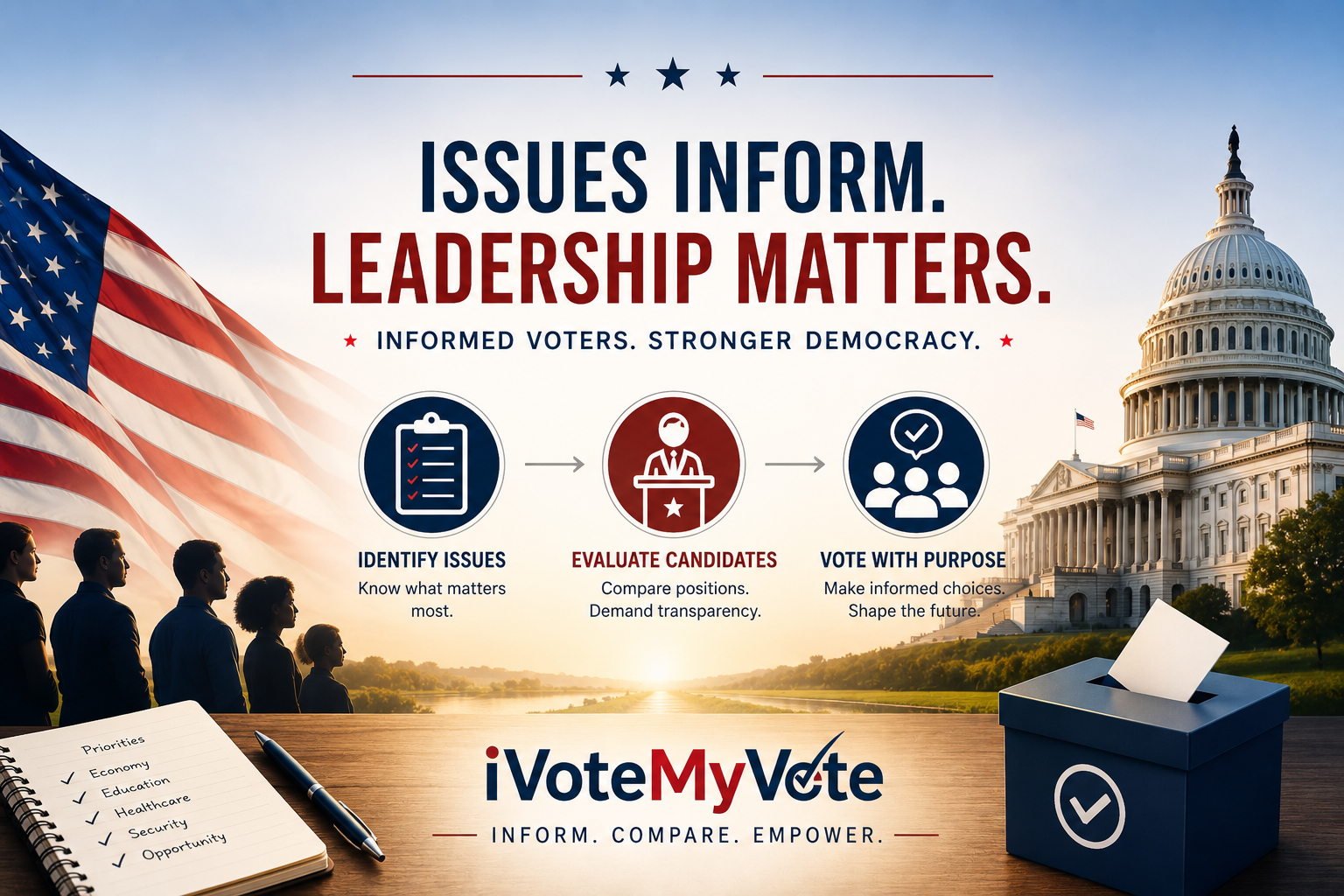
For generations, voters have been asked to make important decisions based upon campaign advertisements, party affiliation, endorsements, and brief policy statements. While these tools provide some information, they often leave voters with an incomplete picture of what candidates truly believe and which issues they consider most important.
At iVoteMyVote (IVMV), we believe voters deserve a clearer view.
What if every candidate could identify, rank, and explain the issues most important to them?
What if voters could compare candidates based upon their actual priorities rather than assumptions based on party labels?
What if candidates were encouraged to explain not only what they believe today, but also why those beliefs may change over time?
These questions have led to the development of a proposed IVMV framework for issue identification and candidate transparency.
Why Issues Matter More Than Labels
Political parties serve important functions within the electoral process, but party labels do not always tell voters everything they need to know.
Two candidates within the same party may have very different priorities.
Likewise, candidates from different parties may share common positions on certain issues.
Voters who focus only on party affiliation may miss important differences—or important similarities.
Issue-based evaluation allows voters to examine candidates more directly.
Instead of asking:
“Which party does this candidate belong to?”
Voters can ask:
“What issues matter most to this candidate?”
“How does this candidate propose to address them?”
“Do these priorities align with my own?”
The Fundamental Five
The first level of the IVMV framework is called the Fundamental Five.
Each candidate identifies the five issues they consider most important.
The candidate ranks those issues from one to five and provides a brief explanation of their position on each.
Examples might include:
- National Debt
- Border Security
- Healthcare
- Education
- Economic Growth
For another candidate, the list may look entirely different.
The purpose is not to judge the priorities.
The purpose is to reveal them.
The Fundamental Five provides voters with an immediate snapshot of what drives a candidate’s campaign and decision-making.
The Essential Eleven
The second level expands the discussion.
The Essential Eleven includes the Fundamental Five plus six additional issues that the candidate considers highly significant.
This creates a broader picture of the candidate’s policy interests and governing philosophy.
Many important issues may not appear in a top-five list but still deserve attention.
The Essential Eleven provides voters with greater depth while remaining manageable and easy to review.
The Fastidious Fifteen
The third level is the Fastidious Fifteen.
This framework expands the candidate’s issue profile to fifteen ranked priorities.
By this point, voters gain a comprehensive understanding of the issues that shape the candidate’s views and policy goals.
The Fastidious Fifteen encourages thoughtful reflection by candidates and allows voters to compare issue priorities across campaigns in a structured and transparent manner.
Transparency Through Time
Perhaps the most valuable feature of this framework is not the initial ranking.
It is the historical record.
Candidates should have the ability to update their positions as circumstances change.
However, updates should not erase previous positions.
Instead, voters should be able to see:
- The original position.
- The revised position.
- The date of the change.
- The candidate’s explanation.
This approach promotes accountability while recognizing that responsible leaders sometimes change their views when presented with new information or changing conditions.
Transparency is not about preventing change.
Transparency is about explaining change.
Benefits for Voters
The framework could help voters:
- Compare candidates more effectively.
- Identify areas of agreement and disagreement.
- Understand candidate priorities.
- Evaluate consistency over time.
- Make more informed voting decisions.
Most importantly, it encourages issue-based voting rather than assumption-based voting.
Benefits for Candidates
Candidates also benefit.
The framework provides an opportunity to:
- Clearly communicate priorities.
- Distinguish themselves from competitors.
- Demonstrate transparency.
- Explain policy evolution.
- Connect with voters who share similar concerns.
Rather than being defined by a party label alone, candidates gain an opportunity to present a more complete picture of their beliefs and priorities.
The IVMV Vision
At its core, this proposal reflects a simple idea:
Better-informed voters make better-informed decisions.
The Fundamental Five, Essential Eleven, and Fastidious Fifteen are not intended to tell voters what to think.
They are intended to help voters understand what candidates think.
A healthy democracy depends upon informed citizens, transparent candidates, and meaningful dialogue about issues that affect our communities, states, and nation.
The more clearly voters understand candidate priorities, the more effectively they can choose representatives whose views align with their own.
Urge Action
Ask the candidates seeking your vote to identify and rank the issues most important to them. Compare those priorities with your own. Look beyond party labels and campaign slogans. Focus on the issues, the explanations, and the consistency of the candidate’s positions over time.
An informed voter is not simply choosing a candidate.
An informed voter is choosing the principles and priorities that will shape future decisions.