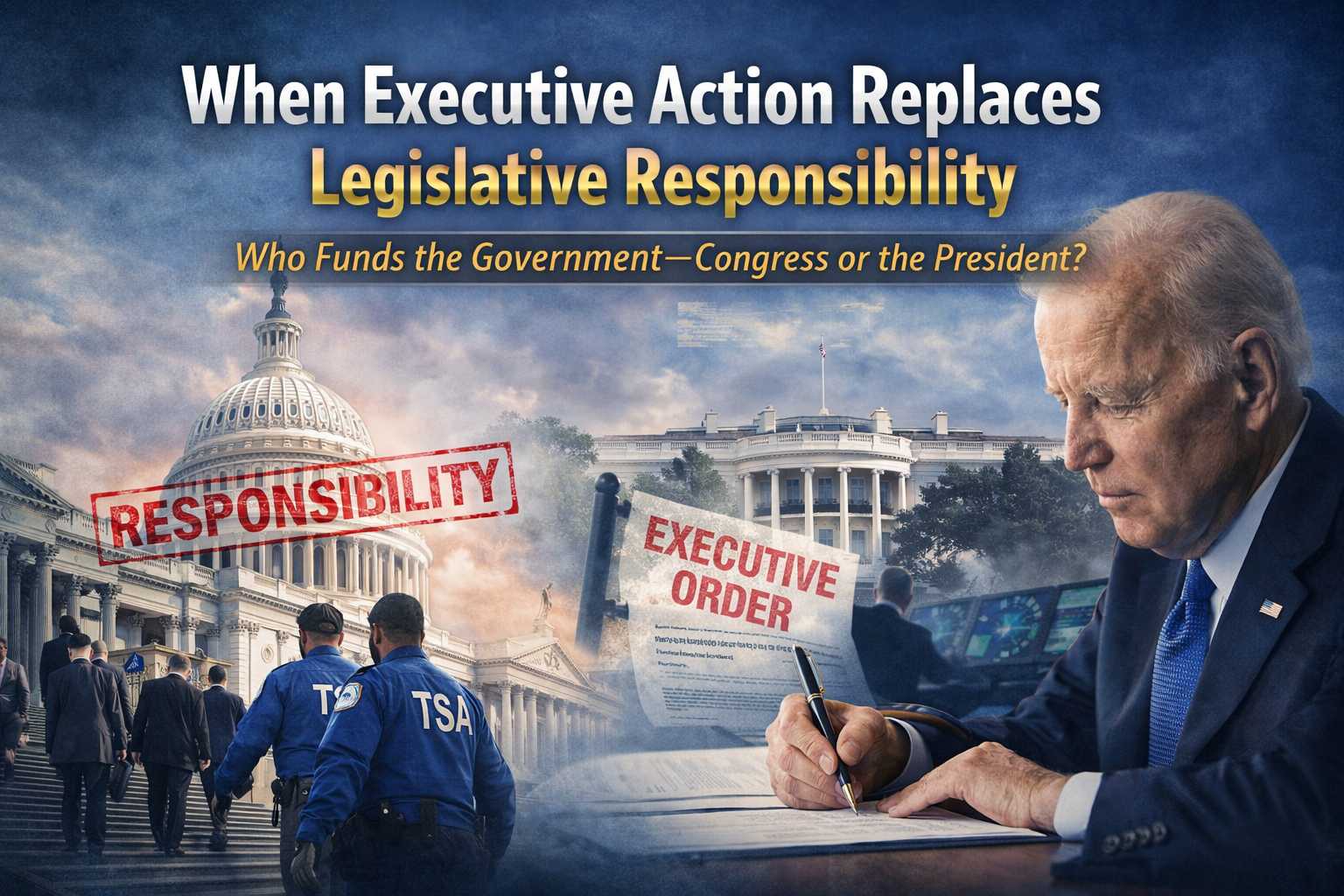
When Responsibility Shifts, Accountability Blurs
In times of government funding delays, a pattern has begun to take shape when Congress does not act in time, the executive branch is often expected to step in and keep essential services running.
While this may prevent immediate disruption, it raises an important question:
Should executive action replace legislative responsibility?
The U.S. system of governance is built on clearly defined roles. When those roles begin to overlap under pressure, accountability can become less clear.
✈️ Real-World Impact: Workers and Travelers

Essential services do not pause when funding is uncertain.
Workers connected to air travel systems such as those supporting the Transportation Security Administration and the Federal Aviation Administration continue showing up every day.
However, when funding is unclear:
- Pay may be delayed or uncertain
- Staffing becomes strained
- Operational efficiency begins to decline
For travelers, this translates into:
- Longer wait times
- Increased delays
- Missed flights and added expenses
⚖️ A System Under Pressure
When Congress does not complete funding decisions on time, the expectation often shifts to the executive branch to “find a way” to maintain operations.
While this may seem practical, it introduces challenges:
- Responsibility becomes less clearly defined
- Temporary fixes replace long-term solutions
- The balance between branches begins to blur
This is not about assigning blame it is about recognizing how the system is meant to function.
🏛️ The Role of Congress
The responsibility to fund government operations belongs to Congress.
That responsibility includes:
- Debating funding priorities
- Negotiating differences
- Reaching decisions within expected timelines
When that process is delayed, others are left to manage the consequences.
A functioning system depends not just on action but on the right branch taking the right action at the right time.
🧭 Why This Matters to Citizens
For many Americans, the details of government structure may feel distant until those structures stop working as expected.
When roles blur:
- Accountability becomes harder to track
- Solutions become temporary rather than stable
- Public confidence can weaken
Citizens rely on clarity both in services and in leadership.
💡 A Balanced Path Forward
A more stable approach may include:
- Timely funding decisions within Congress
- Clear boundaries between legislative and executive roles
- Reduced reliance on last-minute or temporary measures
These are not political positions they are structural expectations.
Understanding how candidates approach responsibility, decision-making, and governance is essential especially in moments when systems are under strain.
Voters have the opportunity to ask:
- Will you act on time?
- Will you prioritize stability in essential services?
- Will you fulfill the responsibilities of your office?
At iVoteMyVote, we help voters evaluate candidates based on real issues and real actions.
Explore where candidates stand and make informed decisions at iVoteMyVote.com.
Written by Claude Tatro, with analytical and language support from Alder (ChatGPT)