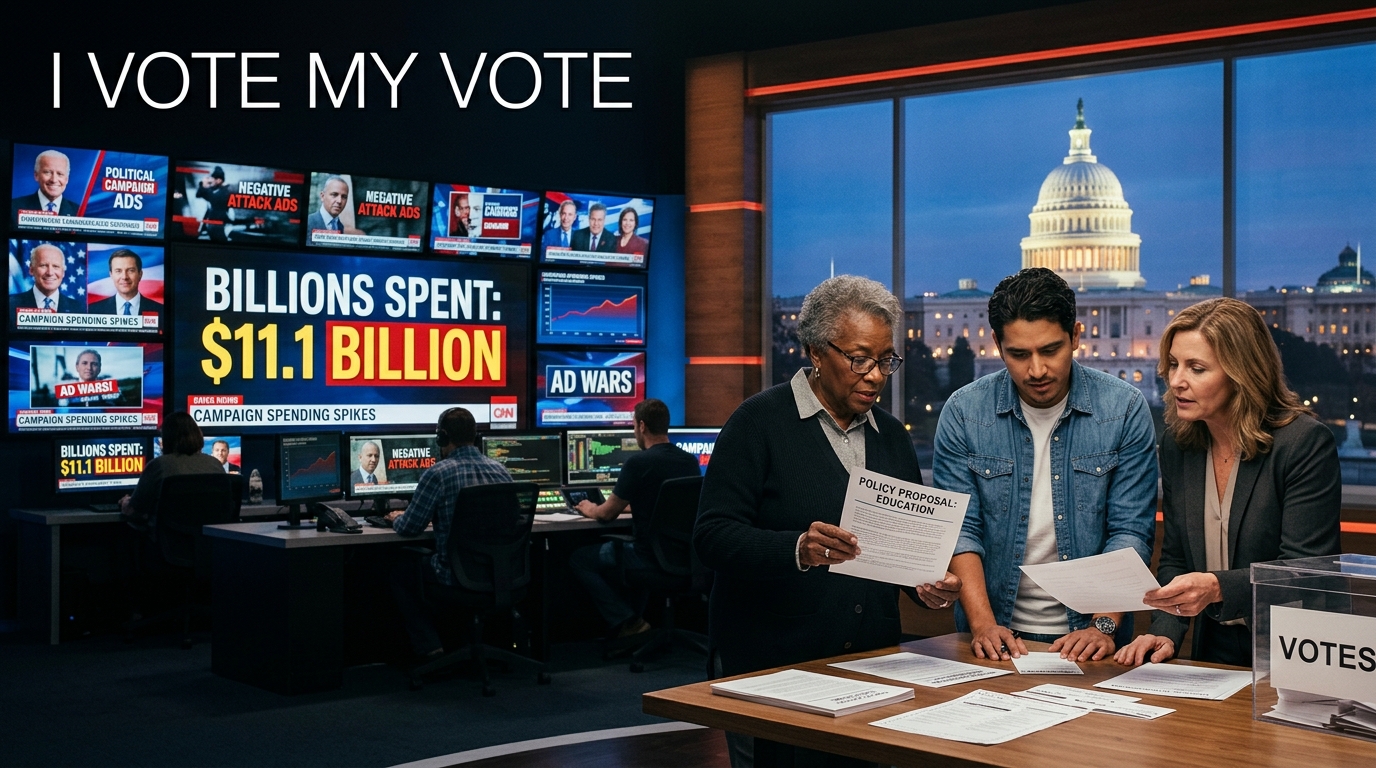
An IVoteMyVote.com Editorial
By Claude George Tatro, Jr. | Founder, IVoteMyVote.com | October 2026
The 60% Substantive Advertising Standard
If political campaigns voluntarily committed at least 60% of their advertising expenditures to substantive public issues, over $6.66 billion of the $11.1 billion spent in 2024 would have directly educated voters on real policies, proposed solutions, and civic accountability.
The Price of Political Campaigning
Every election year, Americans are exposed to an extraordinary volume of political advertising. Television, radio, newspapers, websites, social media, and direct mail carry messages intended to influence our decisions at the ballot box.
The amounts spent are enormous. Yet a fundamental question deserves our attention:
“Are these billions of dollars helping Americans understand the issues, or are they too often being used to attack personalities, create distractions, and influence emotions?”
Political advertising is an important exercise of freedom of speech. Candidates and organizations have the right to communicate their positions and criticize their opponents.
But voters also have a responsibility to examine whether the information presented is relevant, accurate, and useful.
How Much Are We Spending?
The 2024 election provides a revealing illustration of the financial magnitude of American political campaigns.
According to AdImpact, approximately $11.1 billion was spent nationally on political advertising during the 2024 election cycle. Ohio alone accounted for more than $745 million in political advertising expenditures.
The Ohio U.S. Senate contest between incumbent Democrat Sherrod Brown and Republican challenger Bernie Moreno became an extraordinary example of campaign spending. Approximately $541 million was spent on advertising associated with that race during the election cycle.
Ohio’s Senate general election alone generated approximately $483.4 million in advertising spending and more than 222,000 broadcast advertisement airings.
Consider what these numbers represent: hundreds of millions of dollars spent attempting to influence voters in a single Senate election.
Certainly, some advertisements provided useful information concerning inflation, immigration, health care, taxation, and other public issues. But how much of this enormous expenditure genuinely explained proposed solutions, and how much was devoted to personal attacks, unfavorable portrayals, and attempts to discredit opponents?
We should not presume to know the answer without examining the advertising itself. That is precisely why IVoteMyVote.com believes a measurable, voluntary advertising standard deserves consideration.
The Difference Between Spending and Understanding
The United States does not suffer from a shortage of political messages. It suffers when the abundance of those messages does not translate into a better understanding of public policy.
- A candidate may spend millions of dollars telling voters what is wrong with an opponent while providing comparatively little explanation of what the candidate would do differently.
- An advertisement may criticize a voting record without explaining the legislation, its purpose, its consequences, or the circumstances surrounding the vote.
- A personal comparison may attract attention while contributing virtually nothing to the public’s understanding of government.
There is a distinction between informing voters and merely persuading them. Both are legitimate campaign activities, but the public interest is better served when substantial attention is given to issues and proposed solutions.
The IVoteMyVote.com 60% Standard
IVoteMyVote.com proposes that candidates for public office and independent political organizations voluntarily commit to devoting at least 60% of their political advertising expenditures to substantive election issues and proposed solutions.
The remaining 40% would be available for candidate qualifications, personal background, leadership experience, campaign activities, and other legitimate communications.
This is not a proposal to restrict freedom of speech or establish a government-enforced advertising requirement. It is a voluntary commitment that participating candidates and organizations may choose to make publicly.
The purpose is straightforward: to encourage political campaigns to give the majority of their advertising attention to the responsibilities of public office and the issues affecting the American people.
What Would 60% Mean in Dollars?
To illustrate the financial significance of the proposal, consider applying the 60% standard to historical advertising totals from 2024:
| Advertising Scope | Total Expenditures | 60% Issue-Centered Allocation |
|---|---|---|
| United States (National 2024) | $11.1 billion | $6.66 billion |
| Ohio (Statewide 2024) | More than $745 million | More than $447 million |
| Ohio U.S. Senate Contest (2024) | Approximately $541 million | Approximately $324.6 million |
These calculations are illustrations, not measurements of actual issue-centered advertising. They demonstrate the substantial amount of campaign communication that could be directed toward substantive public issues if participants voluntarily adopted the 60% objective.
Imagine the educational value if billions of dollars in political advertising were consistently directed toward explaining the national debt, government spending, taxation, education, health care, national security, and other significant matters.
A Public Record of Voluntary Commitments
IVoteMyVote.com proposes to invite candidates and independent political organizations to register their voluntary commitments on its website. This would establish a public record allowing voters to determine which participating candidates and organizations have pledged to meet the 60% standard.
Such registration would not constitute an endorsement by IVoteMyVote.com, nor would it establish that the participating organization had actually fulfilled its commitment. A pledge is a promise; verification is evidence that the promise has been fulfilled. This distinction must remain clear.
Random Sampling and Future Verification
As IVoteMyVote.com develops, we hope to establish a system of random sampling to examine political advertising and determine the extent to which participating candidates and organizations are meeting their voluntary commitments.
Such reviews might also be undertaken by qualified independent organizations willing to apply transparent and consistent evaluation methods. A credible program would require a defined methodology, appropriate sampling procedures, and an opportunity to correct factual errors.
Recognizing Our Present Limitations
IVoteMyVote.com is presently a developing organization without the staffing or financial resources necessary to conduct systematic random sampling of political advertising. We do not claim to possess an operational compliance-verification program.
Our immediate objective is to establish the voluntary standard and encourage participation. Financial support for such a program must never provide a contributor with control over the advertisements selected or the conclusions reached. Credibility depends upon independence.
The Responsibility of Candidates and Voters
Candidates have every right to explain their qualifications, defend their records, and question the positions and conduct of their opponents. Voters have an equally important responsibility to examine the substance of those communications.
When evaluating a political advertisement, voters might ask:
- What public issue is being addressed?
- What facts support the statements being made?
- What solution is being proposed?
- What are the possible financial and social consequences?
- Have I learned something useful in deciding how to vote?
These questions apply equally across all political affiliations. IVoteMyVote.com does not seek to tell Americans which candidates to support. Our mission is to help voters identify the candidates whose positions most closely correspond to their own considered views on public issues.
What We, the People, Should Expect
The enormous financial investment in American elections deserves thoughtful examination. Campaigns necessarily involve persuasion and criticism, but surely we can encourage campaigns to devote a substantial majority of their resources to the issues that affect the future of our country.
Let us measure the quality of political advertising not simply by the dollars spent or the frequency of airings, but by how effectively it helps Americans understand the choices before them.
IVoteMyVote.com
Your Vote. Your Voice. Your Responsibility.
Sources & Reference Documentation
- OpenSecrets, Cost of Election, 2024 federal election expenditure data.
- AdImpact, 2023–2024 Cycle in Review, political advertising expenditures.
- AdImpact (December 4, 2024), Ohio Senate General Election Saw a Record Breaking $483.4M.
- WTVG (January 2, 2025), Ohio Saw Record Political Spending in 2024.