Why IVMV Supports Economic Participation Starting in Sixth Grade
Much of today’s civic debate begins on college campuses. One visible example is the work of Charlie Kirk and Turning Point USA, whose efforts are based on the belief that many college students, particularly at ideologically liberal institutions, have been guided toward a narrow political framework. Their strategy assumes that thoughtful debate and logical economic arguments can encourage students to reconsider positions they may not have deeply examined.
That assumption is reasonable.
At iVoteMyVote, however, we believe the larger issue begins much earlier. By the time students reach college, many political and economic views are already formed. The real opportunity lies upstream, before ideology hardens and before misunderstanding becomes belief.
Why wait until college when understanding can begin earlier
In an era where public education often struggles to deliver consistent civics and economics instruction, IVMV believes sixth grade is not too early to introduce how a free economic system actually works. Not through political messaging, but through practical participation and observation.
Young people already live inside an economic system every day. They see prices rise and fall. They watch businesses succeed or disappear. They experience scarcity, tradeoffs, and incentives. They feel the effects of inflation long before they learn the word itself.
What is missing is structured guidance that connects these daily experiences to foundational ideas like capital, value, markets, and personal responsibility.
From Abstract Civics to Practical Understanding
Civics becomes real when students understand how economic decisions shape outcomes in the world around them.
Owning even a single share of a company can turn abstract concepts into tangible lessons. Through basic stock ownership and guided discussion, students begin to understand:
-
How businesses create and lose value
-
Why innovation, efficiency, and trust matter
-
How markets respond to risk and opportunity
-
How government policy can support or distort growth
-
How international events influence domestic prosperity
This is not political persuasion. It is economic literacy built through lived experience.
Why Sixth Grade Matters More Than Most People Realize
One of the most important lessons young people can learn is also one of the most overlooked. Time matters more than strategy.
Starting conservative investing in sixth grade provides something that can never be recovered later. Time.
Markets rise, fall, correct, and recover. For short term participants, volatility feels dangerous. For long term participants, it becomes educational and eventually expected.
Starting early allows young investors to:
-
Experience multiple market cycles without panic
-
Learn that downturns are part of normal market behavior
-
See recovery as a recurring feature, not a surprise
-
Build confidence based on observation rather than fear
Over long periods, volatility is absorbed. What appears risky in the short term becomes background noise over decades.
Conservative Investing Builds Strength and Resilience
IVMV emphasizes conservative investing for young participants not to limit growth, but to support stability, learning, and discipline.
Conservative approaches help young investors:
-
Avoid catastrophic loss
-
Develop patience instead of impulse
-
Focus on steady participation rather than reaction
-
Let compounding work quietly over time
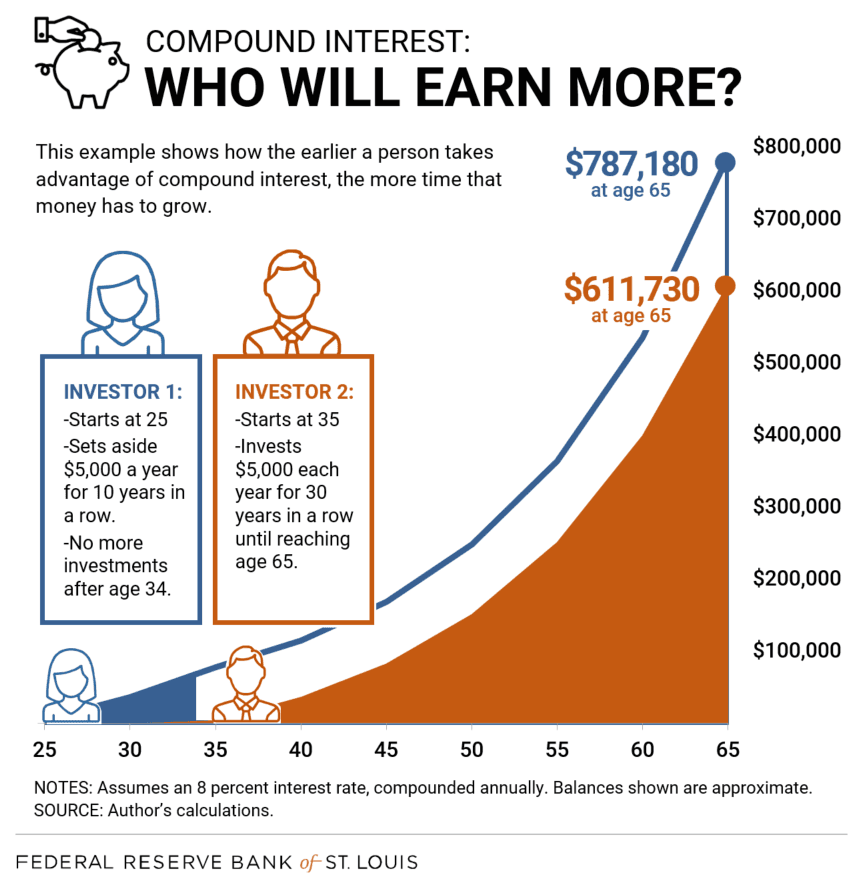
When paired with long exposure to the market, modest conservative returns often outperform aggressive strategies that begin much later in life.
Compounding Is Not Magic. It Is Time Doing Its Job.
Compounding rewards early starts, consistency, and long holding periods.
A small investment made early and left largely undisturbed can grow more than a much larger investment started years later. This reality is mathematical, not ideological.
Teaching this lesson early builds respect for discipline, delayed gratification, and long term thinking. These are skills that extend far beyond finance.

Core Lessons Young Investors Learn Naturally
Early economic participation teaches values that strengthen both individuals and society:
-
Thrift and thoughtful spending
-
How capital grows over time
-
Why inflation reduces purchasing power
-
The relationship between risk and reward
-
The influence of government policy on markets
-
Personal agency and responsibility
These lessons prepare informed citizens far more effectively than slogans or sound bites.
Investment Options Available to Young People
The United States already provides lawful, structured ways for minors to participate in markets under adult supervision.
Custodial Brokerage Accounts
These accounts can be opened for children of almost any age and are managed by a parent or guardian. They allow ownership of individual stocks, ETFs, and mutual funds. Control transfers to the child at adulthood.
Best used for learning how companies perform and how markets behave over time.
Custodial Roth IRA
A Roth IRA for a minor is allowed when the child has legitimate earned income such as babysitting, lawn care, or properly reported family business wages.
Contributions grow tax free and withdrawals in retirement are tax free. The greatest lesson here is time. Starting early demonstrates the power of compounding across decades.
529 Education Investment Plans
While focused on education, these plans introduce long term planning, market exposure, and disciplined saving.
Simulated and Educational Programs
Before real money is involved, students can learn through stock simulations, paper trading platforms, and supervised investment clubs.
These tools provide valuable learning without financial risk.
Guardrails Matter
IVMV does not advocate speculation or unsupervised investing. Responsible guidance includes:
-
Emphasizing long term ownership over frequent trading
-
Avoiding hype driven assets
-
Teaching diversification and patience
-
Reinforcing ethics, legality, and transparency
The goal is understanding, not short term profit.
Why This Strengthens Democracy
Citizens who understand how capital forms, how markets function, and how policy influences outcomes are less vulnerable to emotional or simplistic political narratives.
Economic understanding encourages independent thinking, healthy skepticism, and appreciation for both freedom and responsibility.
This is civic preparation in its most practical form.
We respect efforts to engage students in debate at the college level. But we believe the foundation must be laid earlier, before political identity hardens and before economic misunderstanding turns into ideology.
Teaching young people how the system works empowers them to decide what they believe on their own terms.
That is not partisan.
That is preparation for citizenship.
Vote informed.
Think independently.
Start early.
Written by Claude Tatro, with analytical and language support from Elder (ChatGPT).