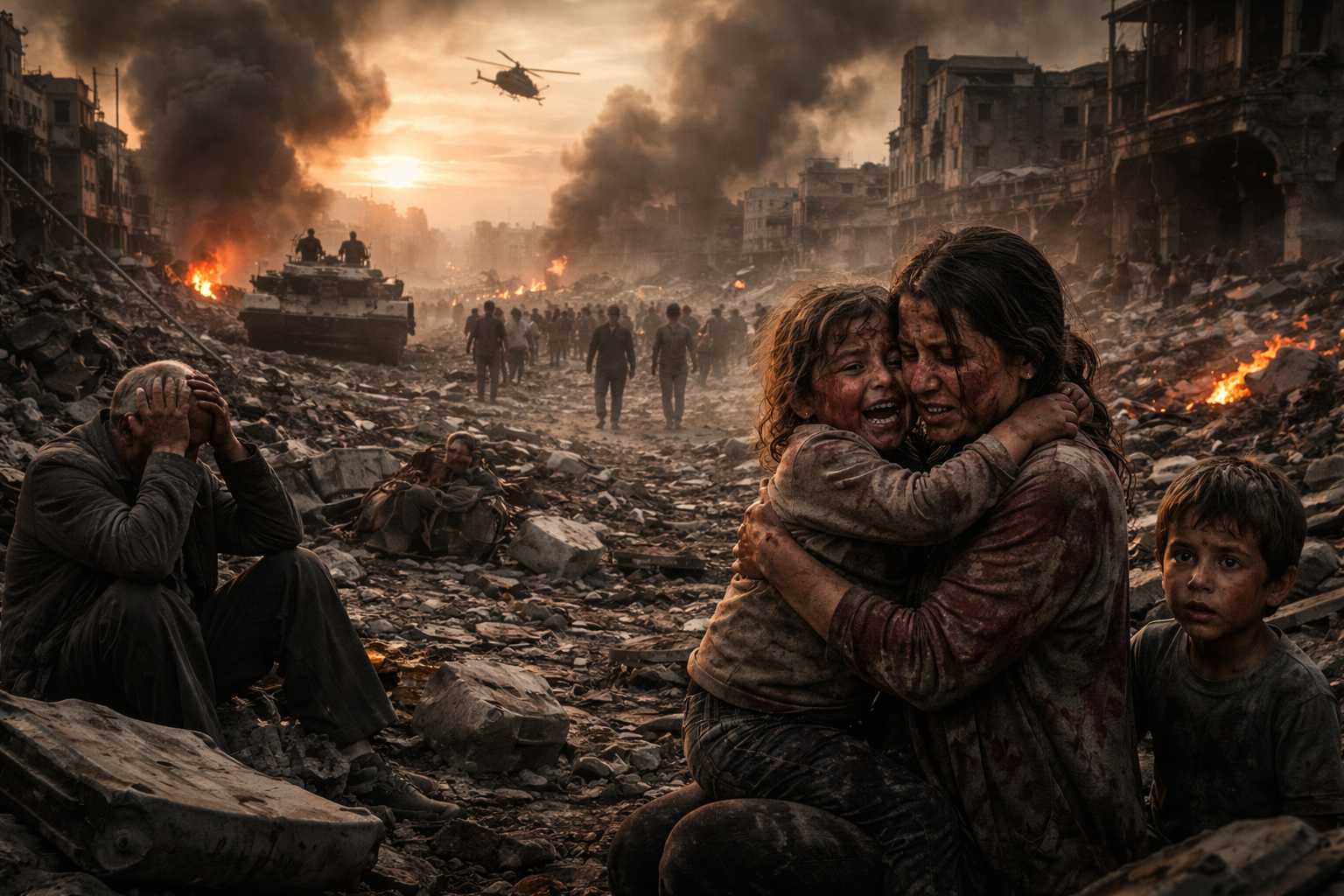
War is often justified with words like security, deterrence, honor, or necessity. But when examined through time, lives lost, and economic destruction, war repeatedly proves itself to be one of humanity’s most wasteful and senseless choices. The conflicts unfolding today show a consistent pattern. Enormous suffering accumulates while political outcomes remain uncertain, delayed, or unchanged.
Below is a factual snapshot of several current wars, expanded to show not just numbers, but what those numbers mean for people and societies.
Russia and Ukraine
The war between Russia and Ukraine began in February 2022 and has now extended well beyond three years. What was initially framed by some as a swift military operation has become a prolonged war of attrition.
Thousands of civilians have been confirmed killed, with many more injured or displaced. Entire cities and towns have been damaged or erased. Families have been separated across borders, and millions remain refugees. Daily civilian casualties continue even as international attention fluctuates.
Economically, Ukraine faces reconstruction needs estimated in the hundreds of billions of dollars. Roads, power systems, housing, hospitals, and schools must all be rebuilt. Russia has also absorbed massive economic costs through sanctions, military spending, and long term isolation. Globally, food and energy markets have been disrupted, increasing prices far beyond the battlefield.
Years of fighting have not produced security or resolution. They have produced exhaustion, grief, and a generation shaped by war.
Israel and Gaza
The conflict that sharply escalated in October 2023 has become one of the deadliest and most destructive episodes in the region’s modern history. Civilian populations have borne the overwhelming burden.
In Gaza, reported fatalities have climbed into the tens of thousands, with daily deaths often reaching staggering levels. Residential areas, medical facilities, and basic infrastructure have been severely damaged. Large portions of the population face displacement, food insecurity, and long term trauma.
Israel has suffered civilian deaths, ongoing security threats, and profound internal strain. The economic cost includes lost productivity, heavy defense expenditures, and prolonged instability. Regional economies have also felt the impact through reduced trade, investment hesitation, and heightened geopolitical risk.
Despite the scale of destruction, lasting peace remains elusive. The violence has hardened positions while multiplying innocent victims.
Yemen
Yemen represents one of the clearest examples of war’s futility. What began as a regional power struggle evolved into a humanitarian catastrophe that has persisted for more than a decade.
Hundreds of thousands have died either directly from violence or indirectly from hunger, disease, and the collapse of health systems. Children have grown up knowing nothing but war, malnutrition, and uncertainty. Daily death rates over the years reflect suffering that rarely captures sustained global attention.
Economically, Yemen’s economy has been devastated. Livelihoods vanished, currency collapsed, and basic services disintegrated. Even if fighting stopped immediately, recovery would take generations.
There is no victory here. Only loss layered upon loss.
Syria
The Syrian civil war has lasted longer than many of today’s soldiers have been alive. What began in 2011 evolved into a complex conflict involving internal factions, foreign powers, and extremist groups.
Hundreds of thousands have died. Millions have been displaced internally or forced to flee the country entirely. Entire neighborhoods remain uninhabitable. Cultural heritage, education systems, and social cohesion have been shattered.
The economic damage is vast. Syria’s national output collapsed, and reconstruction costs reach into the hundreds of billions. For many Syrians, return is still impossible.
After more than a decade, the war stands as a stark reminder that violence rarely produces clarity. It produces scars.
Myanmar
Since the military takeover in 2021, Myanmar has descended into widespread internal conflict. Fighting spans cities, villages, and rural regions, often beyond the reach of journalists or aid workers.
Casualties continue to rise, with violence becoming more frequent and fragmented. Civilians face airstrikes, displacement, and the collapse of basic services. Reliable totals are difficult to confirm, which itself reflects how inaccessible and dangerous conditions have become.
The economy has suffered deeply. Trade declined, investment fled, and poverty increased sharply. What progress had been made over previous decades has been reversed in a few short years.
Power maintained through violence offers no stability. It only prolongs fear.
Ethiopia
The conflict centered around Tigray and other regions revealed how quickly political breakdown can turn into mass suffering. Fighting led to extensive civilian casualties, displacement, and disruption of food supplies.
Estimates of deaths vary widely, but all credible assessments agree that the human toll is severe. Millions were displaced, and access to humanitarian aid was frequently restricted. Entire communities lost years of development in months.
Economic damage includes destroyed infrastructure, reduced agricultural output, and long term harm to national unity. Healing these divisions will require far more effort than preventing them would have.
What These Wars Have in Common
Different histories. Different cultures. Different political systems. Yet the outcomes look disturbingly similar.
Lives lost faster than they can be counted
Children raised in fear instead of classrooms
National wealth converted into rubble
Grievances multiplied rather than resolved
War consumes resources that could strengthen societies and replaces them with trauma that weakens future generations.
The IVMV Perspective
From the IVMV standpoint, war represents a failure of civic responsibility, leadership accountability, and public engagement. When citizens are disconnected from decision making, the costs of war are often paid by those who never chose it.
Peace is not passive. It requires informed voters, ethical leadership, transparency, and systems that reward restraint over escalation.
If war were truly effective, humanity would have learned by now. Instead, we keep repeating the same mistakes with new names and new graves.
The numbers change. The senselessness does not.
Written by Claude Tatro, with analytical and language support from Alder (ChatGPT).